
Messy financials in.Cited report out.
UW Assistant reads a company’s P&L, balance sheet, subscription export and bank statement, in Excel, CSV, PDF or a scan, in English, Swedish or Spanish, and writes an underwriting report where every number cites the cell it came from. Twelve agents do the work; a person answers only what the checks cannot settle.
The product
The model decides what a row means. Code moves the numbers. Arithmetic decides.
The model never writes a number into the report. Every figure is carried by code from its source cell and checked against accounting identities before anyone sees it.
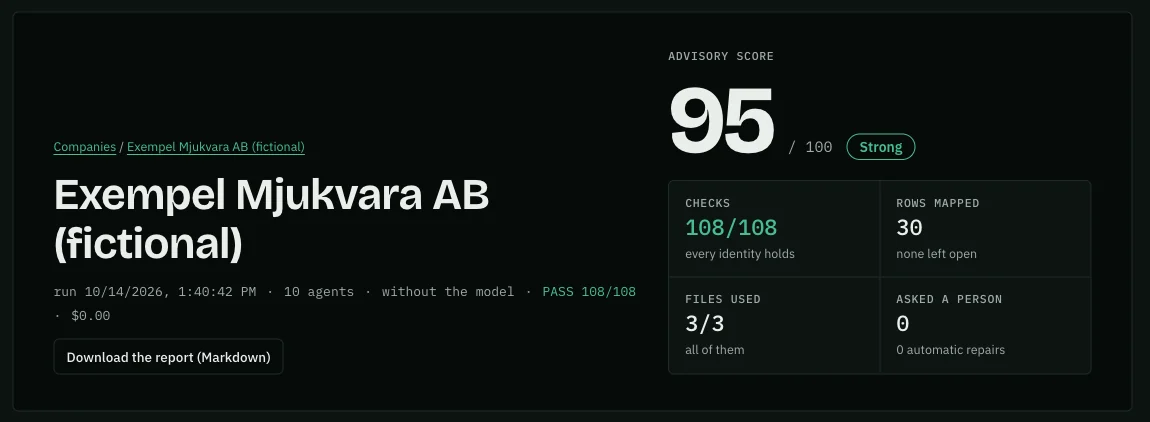
01 · The report
A score you can trace back to a cell.
An advisory score under the lender’s policy, risk findings, 20 key figures and a narrative where every number is inserted by code, and every key figure opens the cells it came from.
- subtotals, balance sheet and bank tie-outs checked on every run
- a subscription file that doesn’t match revenue or the bank is flagged as a risk
02 · Agent steps
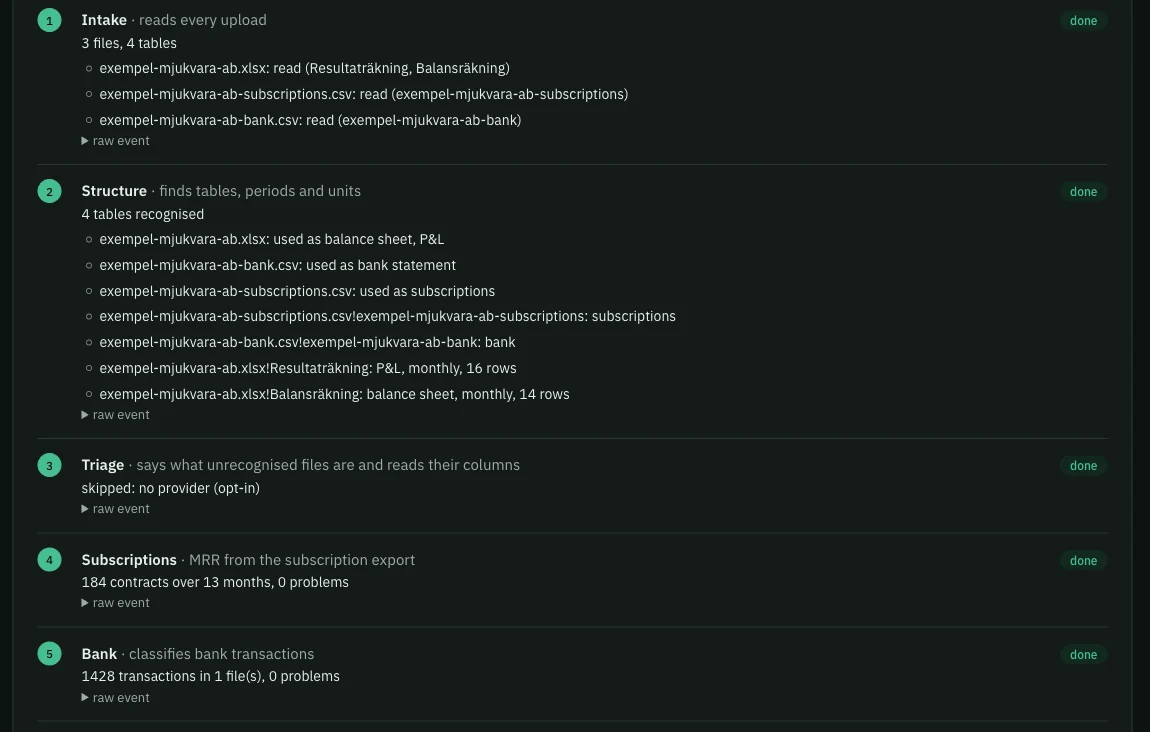
Watch every agent do its one job.
Each run shows what every agent did: which files it read, which tables it found, what it mapped, what it repaired and what it cost.
- Excel, CSV, PDF, scans (OCR) and iXBRL annual reports
- Swedish, Belgian, Spanish and French charts of accounts
03 · Human review
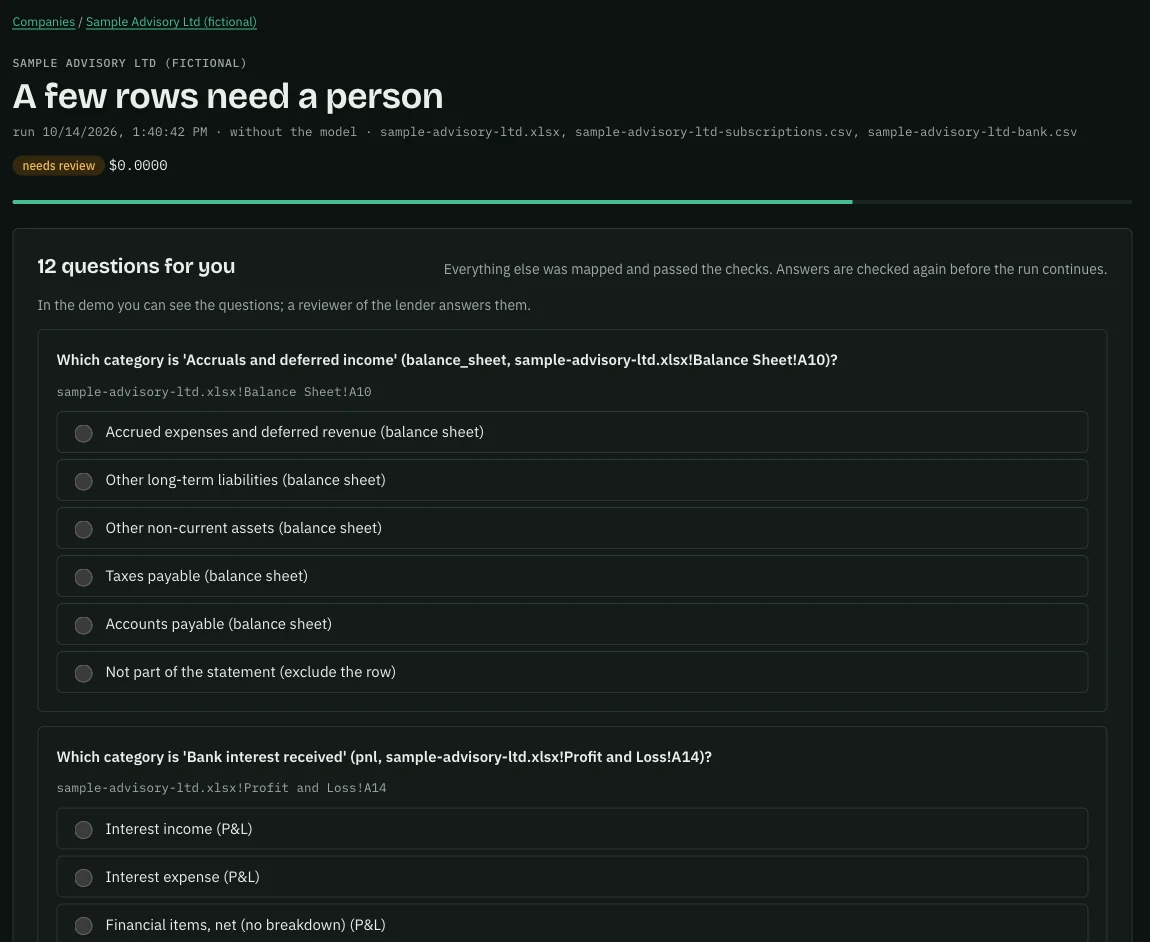
A person answers only what still doesn’t add up.
Rows that fail the checks after repair become short questions with the source cell and the likely options. The answer is remembered for that lender, so the same row maps by itself next time.
- answers are checked again before the run continues
- no question when the figures already prove the mapping
04 · Charts
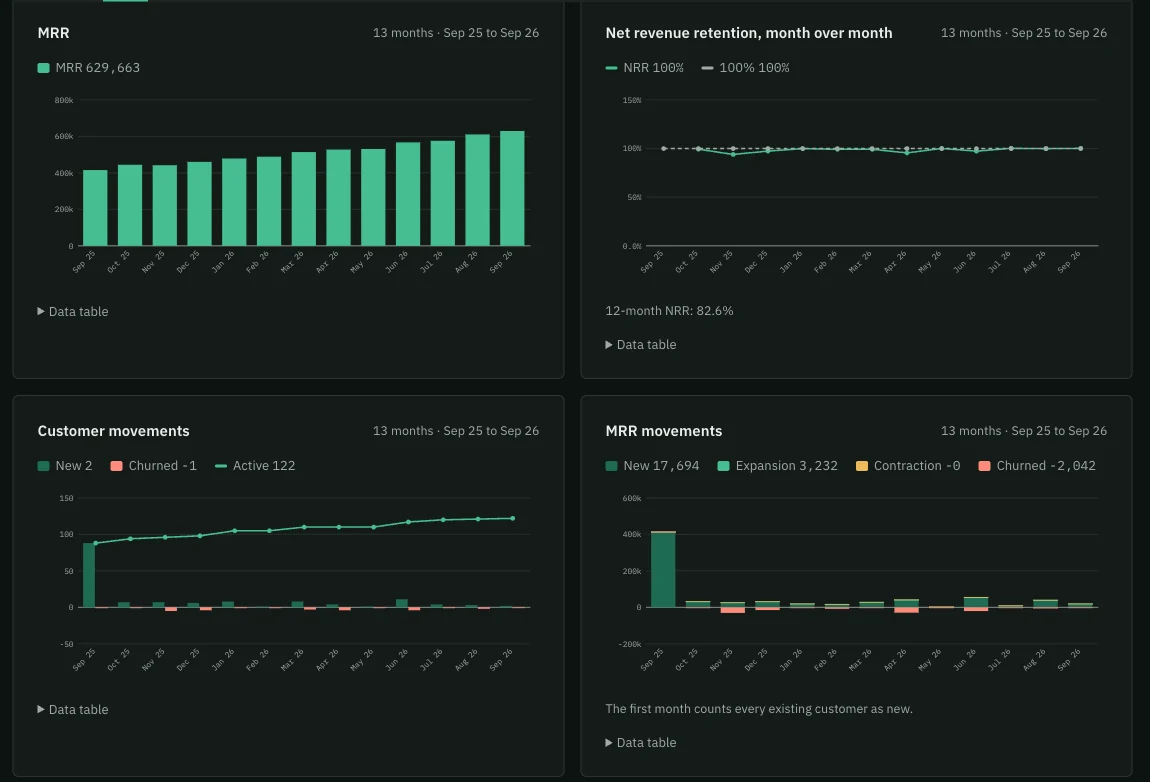
Subscription health at a glance.
MRR, net revenue retention and customer and MRR movements from the subscription export, next to the statements they must agree with.
- MRR, churn and NRR computed by code
- data tables behind every chart
How a run works
Twelve agents, one shared run, one person.
An earlier version asked one prompt to normalise every file, so a person had to check everything. Splitting the work and checking it with arithmetic is what cut human review.
- ReadIntake, structure, triageEvery upload read; tables, periods and units found; unknown files described from headers and row shapes only.
- MapOne taxonomyAliases, chart-of-accounts ranges and embeddings first; the model decides row roles only where those are unsure.
- Check and repairAccounting identitiesSubtotals, balance sheet, P&L to balance sheet and bank. The model proposes fixes; the figures keep or reject them.
- AskOnly what still failsA reviewer at the lender answers in plain words; the answer is reused next time.
- ReportScore, findings, narrative20 key figures by code, a narrative where every number is inserted by code, every model call logged.
Build yours with us
What you get when we build your agent system.
Checks, not hope
Agents whose output is verified
Rules, identities and evaluation sets decide what passes, so a wrong answer is caught instead of shipped.
Cost you know
A budget per run and per workspace
Every model call is logged with what it served; free layers do the work first and the model only where it pays.
Your data stays yours
Multi-tenant and portable
Row-level security per customer, one Docker image, hosted where your data must live.
Have a document-heavy workflow?
Bring the files. We’ll scope it in 30 minutes.
You leave the call with the checks that would make your workflow safe to automate, the parts a person keeps, and what it would cost to run.
Book an AI scoping call →Demo with fictional companies. Evaluation figures come from synthetic test files. UW Assistant gives an advisory analysis; credit decisions stay with the lender. Runs on AWS (Stockholm) today; Azure AI Foundry, Google Vertex AI and AWS Bedrock versions are planned.
Next: Our product · AI · TradeMindAI →